The Strength to Ask for Help
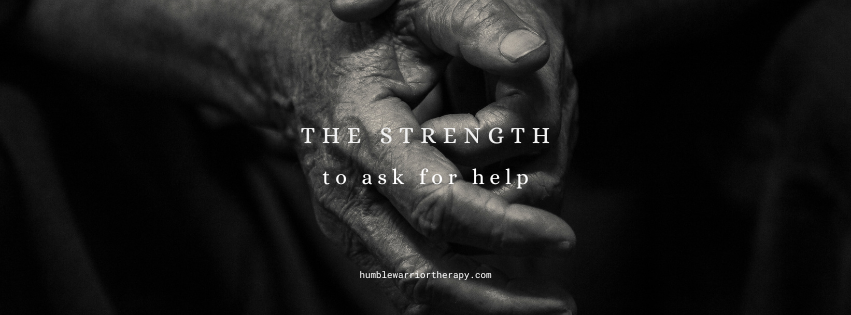
I’ve been thinking a lot about what we ask men to carry.
Be strong.
Figure it out.
Don’t need too much.
Keep moving.
Hold your family together. Hold your work together. Hold yourself together.
And somewhere along the way, needing help became something to overcome instead of something human.
I don’t believe asking for help makes us weaker.
I think sometimes it is one of the bravest things we can do.
Because the moment we admit we cannot do everything alone, we have to let someone else in.
And that is where the real work begins.
When Strength Becomes a Wall
I see this in different ways in my work, but there is something particularly powerful about watching men begin to loosen their grip on the idea that they are supposed to handle everything themselves.
Adam put it simply when I asked him what keeps men from seeking healing:
““It’s wrapped up in our identity not to ask for help. To be strong. To do it on our own. To figure it out.””
There is nothing wrong with strength.
The problem comes when strength becomes a wall.
When being capable means never admitting you are struggling.
When independence means never letting yourself be supported.
When asking for help feels like failure.
The ego is very good at convincing us that we are protecting ourselves when we are actually keeping ourselves disconnected.
And I believe healing asks us to question that story.
Not to become less strong.
To become more whole.
What Happens When Men Do the Work Together
This fall, for the first time, Humble Warrior is creating a space specifically for men to do this work together.
Fall Letting Go: A Sacred Medicine One Day Men’s Retreat will be led by my husband, Dr. Adam Graves, ND, LAc, and Ben Mooney.
I trust both of these men deeply.
They each bring clinical experience, but what matters just as much to me is the kind of presence they bring into a room. The ability to stay grounded. To listen. To create safety. To sit with someone without needing to fix or rush the experience.
There is something meaningful about men being able to enter a space where they don’t have to perform.
No proving.
No pretending.
No need to be the strongest person in the room.
Just an opportunity to show up as you are.
And to discover what becomes possible when you stop trying to carry everything by yourself.
Letting Go Does Not Mean Losing Control
The retreat takes place at Half Moon Ranch, a beautiful 70-acre property with rolling hills, a creek bed, horses, wildlife, and quiet places to step away from the noise of everyday life.
From the moment participants arrive, the intention is to create a different kind of experience.
There is a sage bath, incense, essential oils, the scent of green mandarin in the air. There is time to settle in, meet the other men, share why you came, and begin to feel yourself arrive.
Then we move into the deeper work.
Yoga helps open the body and prepare the mind. Acupuncture supports that connection between mind and body. And from there, participants enter the medicine experience within a carefully held, intentional container.
Adam described his role in a way I love.
The medicine may open the door, but our job is to help people feel safe enough to walk through it.
That distinction matters.
This work is not about forcing an outcome.
It is not about controlling what you discover or deciding ahead of time what your experience should be.
Sometimes the work is simply learning that you can let go and still be safe.
You Don’t Have To Do It Alone
Every retreat has what feels like a connecting thread running through it.
Adam called the trip sitter an anchor.
Someone who stays close, helps you remember to breathe, reminds you that what you are feeling will move through you, and helps you stay grounded when the experience becomes intense.
I think that is a beautiful metaphor for healing itself.
Sometimes we don’t need someone to tell us what to do.
We need someone willing to stay.
To remind us that we are safe.
To help us remember who we are when we temporarily lose our way.
This is part of why I believe so deeply in healing in community.
When one person is struggling, someone else can hold a little more. And when that person finds their footing again, they can become that support for someone else.
That isn’t weakness.
That is interdependence.
That is being human.
The Work Doesn’t End When You Leave
There will be nourishing food prepared with care. There will be time in nature, connection, reflection, and whatever ceremony naturally emerges for the group.
Participants will leave with essential oils and a letter written to their future selves.
But the retreat itself is not the destination.
It is an opening.
Because insight is one thing.
Living differently is another.
That is why the work continues after the retreat through monthly Saturday integration calls, gatherings at Half Moon Ranch, JoyLab, and other opportunities to stay connected to community.
We don’t heal by having one profound experience and then returning to the exact same patterns that brought us there.
We heal by bringing what we discover back into our everyday lives.
By practicing something different.
By allowing ourselves to be supported.
By remembering that we were never meant to do this alone.
Why Plant Medicine?
Adam comes to this work from a very different clinical background than I do.
As a naturopathic doctor and licensed acupuncturist, his training taught him to understand the body through science, logic, systems, and safety.
He sees tremendous value in that.
But he also sees what can happen when healing moves beyond something we simply understand intellectually and becomes something we actually experience.
Plant medicine can create a different kind of opening — one that allows people to explore emotional patterns, connection, and the relationship between mind and body in a deeply experiential way.
Because most of us know what we should do long before we are actually able to do it.
Knowing is not the same as experiencing.
And sometimes the work is creating enough safety to finally experience something differently.
Maybe You Don’t Have To Be So Strong
If you’ve spent years believing you need to figure everything out yourself, asking for help can feel uncomfortable.
Maybe you’ve built a life around being the dependable one.
Maybe you are used to being the person other people lean on.
Maybe there is something you’ve been carrying for a very long time and you don’t quite know how to put it down.
You don’t have to arrive with everything figured out.
You don’t have to know exactly what you’re looking for.
You don’t have to prove that you need this.
You only have to be willing to look.
To loosen your grip.
To let yourself be supported.
To discover that asking for help doesn’t take your strength away.
Maybe it gives you access to a deeper kind of strength.
The kind that doesn’t come from doing everything alone.
The kind that comes from knowing when to reach for another hand.
And having the courage to take it.
Fall Letting Go: A Sacred Medicine One Day Men’s Retreat
Led by Dr. Adam Graves, ND, LAc and Ben Mooney
Half Moon Ranch · Castle Rock, Colorado
If something in you is responding to this, I invite you to learn more and see if this retreat is right for you.
Because sometimes letting go isn’t about giving something up.
Sometimes it’s about finally putting down what you were never meant to carry alone.
LEARN MORE & RESERVE YOUR SPOT →
Rachel Gordon, MA, MEd, is a psychotherapist and founder of Humble Warrior Therapy, where she supports individuals in the Denver area with heart-centered, trauma-informed care.